AI Agents: Types, Capabilities, and UK Guide 2026
Breadcrumb
What are AI agents and why are UK businesses adopting them?
AI agents are software systems that can perceive inputs, interpret context, make decisions, and take action toward a defined goal. In business settings, that usually means handling conversations, retrieving information, triggering workflows, or supporting teams with faster decisions. The category is broad, which is why many companies struggle to separate simple automation from true agent-based systems.
For UK businesses, adoption is being driven by a mix of operational pressure and customer expectations. Teams want to reduce repetitive work, improve service speed, and make better use of internal knowledge without forcing employees or customers into rigid interfaces. That is where AI agents stand out. They can support customer service, internal operations, data handling, and digital product experiences from the same core idea: turning intent into action.
Not every agent works the same way. Some follow strict rules. Others rely on natural language processing, machine learning, or a combination of both. If you want a focused explanation of language-based systems, what are NLP-driven AI agents and how they work gives a deeper breakdown of how they interpret requests and turn them into responses or workflow actions.
This overview is designed to help you understand the landscape first. Once you know the main types, capabilities, and implementation concerns, it becomes much easier to decide where AI agents fit inside your business and which adoption path is realistic.
What types of AI agents should businesses understand first?

The most useful way to classify AI agents is by how they process inputs and decide what to do next. That framework helps you match the technology to the job instead of chasing broad labels.
Rule-based agents
Rule-based agents follow predefined logic such as decision trees, forms, buttons, and keyword triggers. They are useful when requests are narrow, predictable, and heavily controlled.
NLP-driven agents
NLP-driven agents understand natural language, detect intent, and work with more variation in how people communicate. They fit customer interactions, internal help flows, and text-heavy automation. Mid-journey, what are NLP-driven AI agents and how they work can help clarify why these systems behave differently from scripted bots.
ML-powered agents
ML-powered agents use machine learning to classify, predict, rank, or adapt decisions. Some include NLP, while others support recommendation engines, anomaly detection, and workflow optimization outside conversation.
Hybrid agents
Many real deployments are hybrid. They combine rule-based guardrails, NLP understanding, retrieval from knowledge sources, and machine learning for ranking or optimization.
For SMB marketing teams, this distinction matters when sorting inbound queries or qualifying leads. Product managers usually care about in-product guidance and user friction. IT professionals often focus on governance, integration patterns, and where human review should remain in the loop. A good classification model keeps those priorities aligned instead of treating all AI agents as interchangeable.
What can AI agents actually do in customer support and automation?
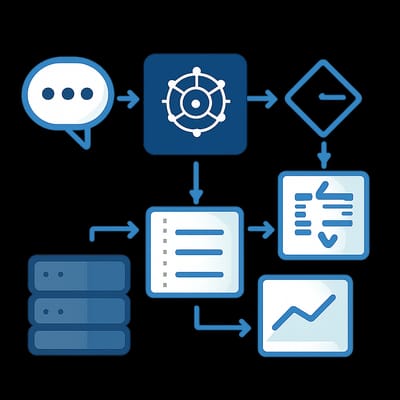
The strongest AI agent capabilities sit at the intersection of language, logic, and system access. An agent becomes useful when it can understand what a user wants, connect that request to business context, and complete a task with a reliable outcome.
Common capabilities
- Answering questions using a knowledge base or approved content
- Routing requests based on intent, urgency, language, or customer type
- Summarising conversations for support teams and handoffs
- Extracting data from emails, forms, and documents
- Triggering workflows in CRM, ticketing, or operations platforms
- Assisting employees with internal policies, procedures, and search
Customer support is often the first proving ground because the value is easy to measure. Faster response times, cleaner escalation paths, and higher self-service rates all create visible outcomes. Data processing is another strong fit, especially when teams need to convert unstructured text into structured records.
In practice, product managers may use agents to improve onboarding or reduce support burden inside software products. SMB marketing teams may use them for lead qualification and campaign response handling. IT professionals often prioritize internal service desks, access requests, and policy guidance where auditability matters.
Related topics such as top use cases in support and data processing deserve deeper standalone treatment, but the principle is consistent across departments: AI agents work best where natural language is common and the next action can be clearly defined.
How do UK implementation, governance, and ROI shape adoption?
A promising AI agent is not the same as a successful deployment. In the UK market, implementation decisions are shaped by data sensitivity, process complexity, budget pressure, and the need to show practical value quickly.
What implementation usually involves
- Defining one narrow business problem
- Mapping user intents and workflow paths
- Connecting the agent to trusted systems and content
- Designing escalation for low-confidence cases
- Measuring outcomes before broad rollout
Governance priorities
Strong governance includes access control, logging, human oversight, approved data sources, and clear update processes. These controls matter whether the agent is customer-facing or internal. They also reduce the risk of inconsistent answers, poor handoffs, or unmanaged model behaviour.
ROI considerations
The clearest ROI often comes from repetitive, measurable work such as support triage, document handling, or internal request routing. Look at time saved, deflection rates, response consistency, and whether teams can handle higher volumes without proportional headcount growth.
For business buyers, implementation should be tied to a specific outcome, not just a general innovation goal. Developers need realistic integration boundaries. IT teams need maintainability and audit readiness. If your organisation is still deciding between rule-based and language-driven systems, comparisons around trade-offs and performance metrics are worth reviewing before any broad investment case is finalised.
A useful next step for many teams is to gather case studies, subscribe for updates on implementation patterns, or request a product demo once a target workflow has been identified.
How should you evaluate vendors, partnerships, and technical fit?
Vendor evaluation becomes easier when you stop asking which platform is best in general and start asking which option fits your business constraints. The right choice depends on your use case, integration needs, governance model, and the level of flexibility you want over time.
Questions to ask during evaluation
- How well does the system handle real language variation?
- What integrations are available for CRM, support, and data tools?
- How are permissions, audit logs, and data boundaries managed?
- What analytics are provided for intent accuracy and fallback rates?
- How much internal effort is needed to maintain and improve performance?
- Can the solution support both current and future workflows?
Partnership quality matters too. A vendor may have strong technology but weak implementation support. That can slow adoption, especially when your team needs help with training data, orchestration, or change management. For product managers, vendor fit often comes down to speed of iteration and measurable experience improvements. For IT professionals, security posture and operational transparency usually carry more weight.
Commercially, avoid judging offers only by entry price. Look at setup effort, usage-based cost growth, support quality, and how well the platform avoids hidden manual work. Teams building a business case often benefit from a whitepaper, side-by-side evaluation framework, and real examples that show how deployment complexity affects long-term ROI.
Good partnerships reduce risk. Great partnerships also make future expansion easier once the first use case proves its value.
What is a practical roadmap for adopting AI agents?
A sensible adoption roadmap starts with one valuable problem, not a full transformation promise. Businesses that succeed with AI agents usually move in stages, testing real user behaviour before expanding scope.
A practical roadmap
- Choose one workflow with clear volume, repeatability, and measurable pain.
- Define success metrics such as handling time, resolution rate, or processing speed.
- Select the agent type that matches the job, whether rule-based, NLP-driven, or hybrid.
- Pilot with real data and include fallback paths for edge cases.
- Review governance before scaling access or adding sensitive systems.
- Expand carefully into nearby workflows once performance is stable.
A support triage pilot might make sense for one organisation, while another may begin with internal document search or marketing intake. SMB marketing teams often benefit from narrow demand-generation or lead-routing workflows. Product managers may see faster returns through onboarding assistance and support deflection. IT professionals often get traction with internal service automation because workflows are structured and measurable.
As you refine the roadmap, what are NLP-driven AI agents and how they work provides useful context for teams choosing a language-based approach. Other subjects, including building chat bots with NLP pipelines and evaluating performance metrics, also become more relevant once you move from overview to implementation.
If you are preparing for adoption, the most useful next steps are to review case studies, document your target workflow, and build a short evaluation brief before talking to vendors.
FAQ about AI agents for UK businesses
What is the difference between an AI agent and a chatbot?
A chatbot is a broad interface category, while an AI agent is defined more by how it interprets context and takes action. Some chatbots are simple scripted tools, but AI agents can connect language understanding, decision logic, and workflow execution.
Are NLP-driven AI agents better than rule-based systems?
Not always. NLP-driven agents are better for varied, natural language inputs and less predictable requests, while rule-based systems are often stronger for narrow, controlled workflows with strict compliance or process limits.
How can SMB marketing teams use AI agents effectively?
SMB marketing teams can use AI agents to qualify leads, answer campaign questions, route enquiries, and capture structured information from free-text messages. The best results usually come from a limited workflow with clear handoff rules.
What should product managers evaluate before launching an AI agent?
Product managers should review user journey fit, fallback experience, intent accuracy, analytics visibility, and how the agent affects onboarding or support friction. It is also important to confirm that the agent supports measurable product outcomes.
What do IT professionals need to check before implementation?
IT professionals should validate integration methods, identity controls, audit logs, data boundaries, uptime expectations, and escalation processes. Strong governance matters as much as model quality.
What are the best first use cases for UK businesses?
Common starting points include customer support triage, internal knowledge retrieval, email and document classification, and employee service requests. These areas are usually easier to measure and govern than broad open-ended deployments.
How should businesses measure AI agent ROI?
Track metrics such as reduced handling time, higher self-service resolution, faster processing, fewer routing errors, and improved consistency. ROI is easier to defend when you compare outcomes against a clear baseline before launch.
When should a business request a product demo or case studies?
A demo or case-study review is most useful once you have defined the target workflow, success metrics, and technical constraints. That way, you can evaluate real fit rather than generic platform claims.