AI Types: Overview, Capabilities, and Use Cases
Breadcrumb
What does the category of AI types actually include?
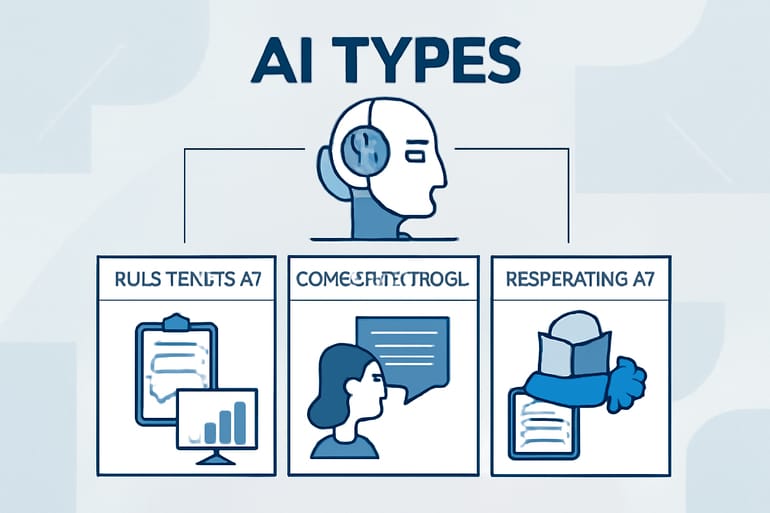
AI types is a broad category that covers the major ways artificial intelligence systems are designed, deployed, and used in practice. Some AI tools are built for conversation, some for prediction, some for workflow automation, and others for decision support. The category matters because people often talk about AI as if it were one thing, when in reality the best choice depends on the task, data, and level of control you need.
A useful way to think about the space is by function. Some systems focus on language understanding and interaction. Others classify data, detect patterns, generate content, or trigger actions across connected platforms. Within business environments, these differences shape how AI is evaluated, governed, and integrated into day-to-day operations.
For developers, understanding AI types helps with architecture choices, integration planning, and system boundaries. For business buyers, it improves purchasing decisions by separating hype from practical fit. That distinction matters whether you are exploring customer support automation, internal workflow assistance, or data-heavy operational use cases.
Different teams will care about different outcomes. An SMB marketing team may want faster lead handling and content support. A product manager may care about onboarding guidance or in-app assistance. An IT professional will usually focus on security, auditability, and whether the system can operate reliably within existing infrastructure. A strong category overview should make those differences easier to understand before you go deeper into specific models, tools, or deployment patterns.
How are the main types of AI separated in practice?
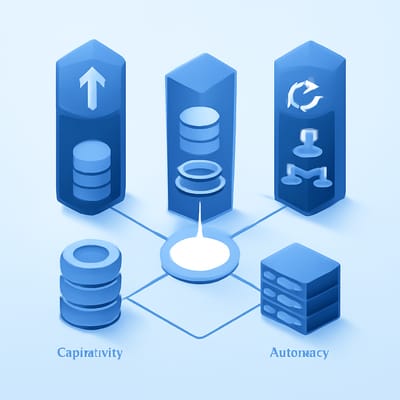
The main types of AI are often separated by capability, data dependency, and how much autonomy they have in a workflow. In practical business use, the distinctions are less theoretical and more operational.
Common ways to group AI systems
- Conversational AI for chat, search, and natural-language assistance
- Rule-based systems for structured logic and predictable decision trees
- Machine learning systems for classification, scoring, forecasting, and pattern detection
- Generative systems for creating text, images, code, or summaries
- Automation-focused agents for completing tasks across tools and workflows
These categories often overlap. A support assistant, for example, may combine conversational AI for language input, rules for permissions, and machine learning for routing or prioritization. That is why category pages should help you understand both the labels and the real-world combinations behind them.
In the current market, one of the most important distinctions is between language-focused AI systems and more deterministic tools. That is where topics such as NLP-driven agents, rule-based agents, and ML-powered chat bots become especially relevant. They represent different approaches to handling user intent, business logic, and reliability.
For a product manager, the question may be which model improves user experience without creating unnecessary complexity. For an IT team, the same question may be about governance and control. For a business buyer, it often comes down to which type of system creates measurable value without overcomplicating deployment.
Which capabilities matter most across AI categories?

Across the category, the most important AI capabilities are the ones that make systems useful in real workflows rather than impressive in demos. Capabilities should always be evaluated in context: what job is the AI supposed to do, and what business result should follow?
High-value capabilities across AI types
- Understanding input through text, voice, structured data, or events
- Recognizing patterns for predictions, recommendations, or anomaly detection
- Generating outputs such as responses, summaries, classifications, or content drafts
- Taking action through APIs, automation tools, and business systems
- Handling context across sessions, users, or workflow stages
- Escalating safely when confidence is low or approval is required
These capabilities show up differently depending on the system. A conversational assistant may emphasize intent detection and retrieval. A forecasting engine may emphasize pattern recognition. An automation-focused agent may prioritize task execution and decision handoffs.
For SMB marketing teams, practical value often comes from faster campaign support, better query handling, or quicker access to lead information. Product managers may prioritize guided experiences, product discovery, and lower support burden. IT professionals will often judge capabilities by resilience, observability, and whether the system respects access controls.
The important takeaway is that capabilities should be matched to workflows, not to marketing language. A tool that claims broad intelligence may still be the wrong fit if it cannot integrate well, explain decisions, or operate within your governance requirements.
Where do AI types create business value and ROI?
Different AI types create value in different ways, but the strongest ROI usually comes from repetitive, measurable, and high-volume tasks. That is true whether the system is used for customer support, internal operations, analytics, or workflow automation.
Common areas where AI delivers value
- Customer support through self-service, triage, and faster routing
- Marketing operations through lead handling, segmentation, and content assistance
- Product experience through in-app guidance and reduced friction
- IT and internal service desks through ticket handling and request automation
- Data processing through classification, extraction, and retrieval
The business case improves when teams can compare current performance against post-deployment results. Useful metrics might include response time, resolution accuracy, hours saved, support deflection, conversion speed, or user satisfaction. Without that baseline, ROI becomes a vague promise instead of a measurable outcome.
This is also where category understanding becomes practical. A rule-based system may offer low-cost control for a narrow workflow. A conversational AI tool may improve self-service adoption. A more advanced agent may create value by linking language understanding with automation across business systems.
If you are evaluating next steps, it helps to think in terms of one workflow at a time. That makes future deep dives into customer support use cases, data processing, and AI performance metrics much more useful because they connect directly to operational decisions rather than general interest.
What should you review before adoption and deployment?
Before adopting any AI system, you need to assess more than features. The strongest deployments come from aligning AI capabilities with governance, technical readiness, and realistic operating costs.
Key evaluation areas
- Data quality and data access requirements
- Integration fit with existing systems
- Security controls and auditability
- Model behavior in edge cases
- Ongoing maintenance and review effort
- Vendor support or internal build capacity
A common mistake is selecting a tool because it performs well in a demo without checking whether it can operate safely and consistently in production. That matters even more in regulated, security-conscious, or customer-facing environments. IT professionals will typically lead on access control, logging, and infrastructure questions, but business stakeholders also need clarity on ownership and process impact.
Product managers should review how the AI fits into the user journey and whether it improves outcomes or simply adds another interface. SMB marketing teams should check how easily workflows can be updated as campaigns, messaging, and lead criteria change. Developers will want to know how flexible the system is when requirements evolve.
This category is broad, so not every article can answer every implementation question. That is why focused topics such as NLP pipelines, agent trade-offs, and performance evaluation deserve separate treatment when you are ready to move from overview to execution.
How should you navigate this category as your needs evolve?
The best way to navigate AI types is to move from broad understanding to targeted evaluation. Start by identifying the kind of problem you need to solve, then narrow the field by capability, control requirements, and expected ROI.
A team exploring conversational assistance may need to compare NLP-driven approaches with more structured rule-based systems. A business focused on automation may need to understand when an agent should only answer questions and when it should take action across connected tools. Over time, the category becomes easier to navigate when you sort options by use case rather than by buzzwords.
This matters because adoption rarely happens all at once. An organization may start with one support workflow, expand into internal service automation, and later evaluate more advanced deployment patterns. Along the way, resources such as case studies, newsletters, whitepapers, and product demos can help teams compare practical options and avoid unrealistic expectations.
For developers and technical buyers, the next step is often to map architecture and integration needs. For business stakeholders, it is usually to define success metrics and review realistic implementation pathways. For mixed teams, the smartest move is often a small pilot with clear KPIs and governance guardrails.
As you go deeper, topics like NLP-driven agents, rule-based trade-offs, AI performance metrics, and customer support use cases become more relevant because they answer narrower questions with much greater depth.
FAQ about AI types and category decisions
What does “AI types” mean in a business context?
It refers to the major categories of AI systems used for different tasks, such as conversation, prediction, automation, generation, and decision support. The term helps teams compare tools based on function rather than broad marketing claims.
Which AI type is best for SMB marketing teams?
That depends on the workflow. Conversational and automation-focused systems are often useful for lead handling, campaign support, and faster access to performance information.
What should product managers look for when comparing AI types?
Product managers should focus on workflow fit, user experience, integration potential, and measurable outcomes. The right system should reduce friction and support product goals rather than add complexity.
Why do IT professionals care so much about AI category differences?
Different AI types create different governance, security, and infrastructure demands. A simple rule-based system may be easier to control, while a more adaptive agent may require stronger monitoring, auditability, and fallback design.
Are conversational AI and AI agents the same thing?
Not always. Conversational AI focuses on understanding and responding to language, while AI agents often include an added action layer that can retrieve data, trigger workflows, or make bounded decisions.
How do you decide between rule-based and more adaptive AI systems?
Start with the workflow. If predictability and strict control matter most, rule-based logic may be enough. If users express requests in varied ways and need more natural interaction, a more adaptive language-focused system may be a better fit.
What is the best way to measure ROI across AI types?
Use workflow-specific metrics such as time saved, response speed, resolution accuracy, support deflection, or conversion improvement. Broad promises are less useful than before-and-after operational data.
When should a team move from category research to a product demo?
Usually after narrowing the use case, identifying key requirements, and defining success metrics. A demo is most valuable when you can test it against a real operational scenario.