NLP-Driven AI Agents: How They Work in 2026
Breadcrumb
Why do NLP-driven AI agents matter now?
NLP-driven AI agents are software systems that interpret human language, extract meaning, and take action based on what a person asks or what a workflow requires. Unlike simple scripts, they can handle variation in wording, messy input, and multi-step conversations. That makes them useful anywhere people communicate in natural language, from customer support queues to internal knowledge search and process automation.
For developers and business buyers, the appeal is practical: these agents can reduce repetitive work, improve response speed, and make automation feel more usable to real people. A product manager may use them to streamline ticket triage, while an IT professional may apply them to service desk routing or document classification. In a smaller organization, a marketing team might rely on one to qualify inbound leads or organize campaign feedback without building a large custom system.
A common point of confusion is the difference between an AI agent and a chat bot. Some chat bots are narrow interfaces with fixed logic, while some AI agents can reason across tasks, retrieve data, and trigger downstream actions. If you want a broader baseline first, what are NLP-driven AI agents and how they work provides the core framing. The key takeaway is simple: language is the interface, but the real value comes from the agent's ability to connect intent to action.
How do NLP-driven AI agents actually work?
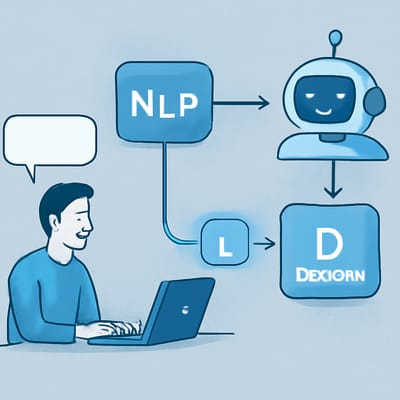
At a high level, an NLP-driven agent turns language into decisions through a sequence of steps. The exact stack varies, but most systems follow a familiar pattern.
- Input capture: The agent receives text or speech from a user.
- Language understanding: It identifies intent, entities, sentiment, or relevant context.
- Context handling: It checks memory, conversation history, rules, or external data.
- Decision logic: It selects a response, tool, workflow, or next action.
- Execution: It sends a reply, updates a system, routes a task, or triggers automation.
- Feedback loop: It logs outcomes for tuning, testing, and governance.
This is why NLP agents sit between classic chat interfaces and more capable workflow automation. They do not just match words. They interpret language in context, then connect that understanding to business systems. In practice, that may mean identifying a refund request, looking up order status, and deciding whether to answer directly or escalate.
Architecture matters here. Retrieval layers, prompt orchestration, confidence thresholds, and guardrails all affect reliability. If you are thinking about implementation, how to build a chat bot using NLP pipelines explains how these components fit together in a more technical workflow. Strong design usually matters more than flashy features.
What can NLP-driven agents do better than simple chat bots?
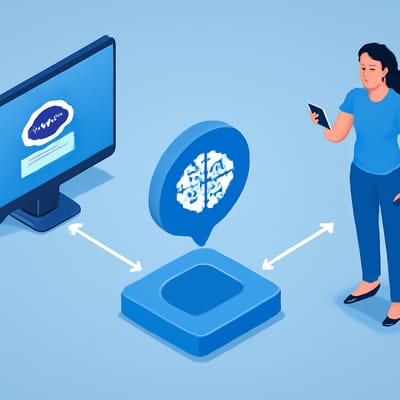
The biggest advantage of NLP-driven agents is flexibility. A basic chat bot usually follows prewritten flows and works best when users stay inside expected wording. An NLP-driven system can handle broader phrasing, infer intent from partial requests, and maintain context across multiple turns. That opens up more useful business applications.
Common capabilities include:
- Customer support automation for FAQs, triage, and escalation
- Data extraction from emails, forms, and support messages
- Workflow triggering such as assigning tickets or updating CRM records
- Knowledge retrieval across policies, product docs, or internal wikis
- Conversation summarization for handoff, analytics, and reporting
For SMB marketing teams, this can mean qualifying leads from free-text inquiries and tagging campaign responses automatically. Product managers often use these agents to surface recurring feature requests from unstructured feedback. IT professionals may focus more on service desk automation, access requests, or incident categorization.
Still, more capability does not always mean better fit. Predictable tasks with strict logic can perform well with simpler designs. That trade-off becomes clearer in nLP-driven vs rule-based agents: use cases and trade-offs, which is especially useful when you are deciding between flexibility and control. The right choice depends on language variability, compliance needs, and how costly mistakes would be.
How are NLP-driven, ML-powered, and rule-based agents different?
These categories overlap, but they solve problems in different ways. Rule-based agents rely on explicit decision trees and scripted responses. They are easier to predict and audit, which helps in narrow, high-control scenarios. NLP-driven agents focus on understanding and responding to language, often using classification, entity extraction, retrieval, and orchestration layers. ML-powered agents is a broader label that may include recommendation systems, predictive models, or adaptive decision engines that do not necessarily center on conversation.
A simple comparison helps:
| Approach | Best for | Main strength | Main limitation |
|---|---|---|---|
| Rule-based | Fixed workflows | Predictability | Poor handling of variation |
| NLP-driven | Conversational tasks | Language flexibility | Requires tuning and monitoring |
| ML-powered | Prediction and adaptation | Pattern discovery | Can be harder to explain |
In real deployments, teams often combine methods. An agent may use NLP to understand requests, rules to enforce policy, and ML models to rank responses or detect anomalies. That hybrid design is often the most practical path because it balances usability with governance.
This matters during evaluation. If your goal is support deflection, conversational understanding may matter most. If your goal is structured approval routing, deterministic logic may be safer. A fuller look at performance metrics, testing, and ROI is worth considering early, especially before a pilot expands into production.
What should you evaluate before deploying an NLP agent?
Before rollout, focus on whether the agent can deliver reliable outcomes in your real operating environment. Many teams evaluate features first and discover too late that integration, governance, and cost control matter more.
Start with these questions:
- Use case clarity: What exact task should the agent automate or assist?
- Data quality: Are conversations, documents, and knowledge sources accurate enough?
- Integration needs: Does it need CRM, ticketing, ERP, or internal system access?
- Risk controls: What should trigger escalation, review, or human approval?
- Success metrics: Will you measure containment, accuracy, resolution time, or ROI?
- Operating cost: What will usage, maintenance, and oversight cost over time?
Business buyers usually care about time to value, total cost, and governance. Developers often focus on pipeline quality, testing, and observability. Product managers need adoption signals and clear user outcomes. For IT teams, security, auditability, and permission boundaries are often the deciding factors.
A sensible pilot is narrow, measurable, and tied to one business process. For example, you might automate a single support queue, a lead qualification workflow, or internal knowledge retrieval for one department. If you want ongoing insight, sign up for updates and case studies that show how teams scope pilots without overcommitting. When the use case is complex or resource-constrained, requesting a product demo can help you judge fit before investing in custom implementation.
How do governance, ROI, and implementation shape success?
An NLP agent is rarely successful because of language understanding alone. Success usually comes from governance, clear ownership, and a measured rollout plan. Teams need policies for hallucination risk, escalation, logging, privacy, and content freshness. Without that structure, even a technically strong agent can create inconsistent answers or operational friction.
ROI tends to come from a few predictable places:
- lower handling time for repetitive requests
- reduced manual triage and tagging
- faster access to internal knowledge
- better consistency in user responses
- smoother handoff between self-service and human teams
Implementation should move in stages: define the task, map the workflow, test on real inputs, add guardrails, then expand slowly. That is especially important when multiple teams are involved. A marketing function may care about conversion quality, while IT focuses on controls and uptime. Product managers often sit in the middle, translating user experience goals into practical requirements.
For organizations comparing build versus buy, a deeper whitepaper or product demo can clarify architecture choices, cost models, and support expectations. Case studies are also useful because they show where value appeared first, which is often in one narrow workflow rather than a broad enterprise launch. The strongest deployments are not the most ambitious on day one. They are the ones that start with a defined problem and prove value quickly.
Frequently asked questions about NLP-driven AI agents
What is the difference between an NLP-driven AI agent and a chat bot?
A chat bot is an interface pattern, while an NLP-driven AI agent is a capability layer that understands language and can take actions. Some chat bots are simple scripted tools, but others are powered by NLP and connected to workflows, data, and business systems.
When should a business choose an NLP-driven agent instead of a rule-based tool?
Choose an NLP-driven approach when user language varies a lot and the task requires intent detection, context handling, or flexible responses. Rule-based tools are often better for narrow, predictable tasks where control and auditability matter more than adaptability.
Are NLP-driven AI agents suitable for SMB marketing teams?
Yes, especially for lead qualification, campaign inquiry routing, survey analysis, and tagging unstructured feedback. The key is to start with one measurable workflow rather than trying to automate the entire customer journey at once.
How can product managers evaluate whether an NLP agent is working well?
Product managers should look at task completion, user satisfaction, fallback rates, escalation quality, and downstream business impact. It also helps to review conversation transcripts so you can see where users are confused, where context is lost, and where the agent needs refinement.
What should IT professionals check before deployment?
IT teams should review data access, identity controls, logging, integration boundaries, uptime expectations, and human escalation paths. Governance is just as important as model quality because operational risk often comes from poor permissions or weak monitoring.
Do NLP-driven agents always use machine learning?
Not always in the same way. Many use machine learning for language classification or ranking, but they may also rely on rules, retrieval systems, and workflow logic. In production, hybrid designs are common because they are easier to control and optimize.
How do you measure ROI for an NLP-driven AI agent?
Measure ROI through time saved, lower support costs, faster resolution, improved consistency, and better conversion or service outcomes. A useful baseline before launch makes it much easier to prove whether the agent is creating real operational value.
Should you build an NLP-driven agent internally or use a vendor?
That depends on your team, timeline, compliance needs, and integration complexity. Internal builds offer more control, while vendor platforms can reduce implementation time and provide support, tooling, and faster pilot delivery.